By Audrey Fong
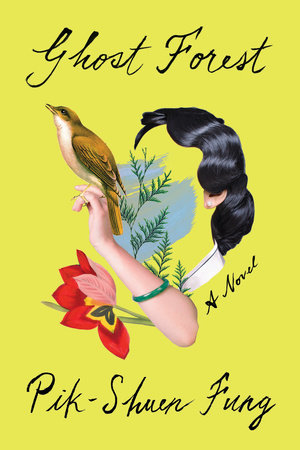
Pik-Shuen Fung’s debut novel Ghost Forest opens with a quotation from Sandro Cisneros’ The House on Mango Street: “I put it down on paper and then the ghost does not ache so much.” This quotation sets up much of Fung’s novel, a meditation on the displacement of a family, the loss of a father, and the ensuing grief one experiences. Essentially, the novel’s unnamed narrator is putting down on paper her experience so as not to “ache so much.”
The story opens with the narrator immigrating from Hong Kong to Vancouver in the years leading up to the U.K. handover of Hong Kong back to China. Worried about what will happen in the handover, the narrator, her mother, and her grandparents move to Vancouver while the father stays in Hong Kong to continue working. The narrator clarifies that this was not an abnormal choice for a Hong Kong family, stating that she “had many classmates whose fathers stayed in Hong Kong for work too” and that she “didn’t think of [her] family as different.” By adding this, Fung contextualizes her novel and the narrator’s experience in the much larger history surrounding Chinese migration and Hong Kong.

While mostly composed of anecdotes and thoughts one to three pages long, the general plot line of Ghost Forest follows the narrator’s childhood in Vancouver, her family’s experience being split between two countries, and her father’s illness. Occasionally, Fung mixes in memories from the narrator’s mother and grandmother as well to provide intergenerational insight into the family (like her mother’s triumph as a basketball player) and to situate the novel within Chinese history (like how her grandmother would read by candlelight as bombs fell outside her home). The majority of these anecdotes are not critical to the plot line, but they add a tenderness and relatability to it. Moments like the grandmother making the narrator afternoon snacks – sliced crystal pears, potstickers, and sticky rice rolls stuffed with seaweed, pork floss, and potato chips – and the family’s visits to Chinatown for groceries and Chinese herbs are especially relatable for Chinese American readers.
Ghost Forest reaches its most poignant moments when the narrator’s father falls ill. The narrator, her mother, and her sister fly between their homes and Hong Kong to care for the father as he grows increasingly sick in the hospital. For the sisters, these visits are also a way to get to know their father after having grown up separated in two separate countries. The narrator struggles to deal with her feelings towards her father, trying to express how much she loves him, but often coming up short having grown up in a family that doesn’t verbalize their feelings. All three of them beg him to stay alive for them, telling him he needs to fulfill his promises of going on vacation with them among other promises – all of which are desperate acts to try to prove to him there’s so much worth living for still. Fung uses the narrator’s experience of grappling with her father’s illness as a clear example of the process earlier mentioned in the Cisnero quote of putting experiences down on paper so that they do not “ache so much.”
Fung emphasizes the permanence of this ache by including that the narrator’s grandmother “has missed her grandmother for over fifty years, and that is so much longer than [the narrator has] been alive.” By showing how death has affected each generation of the narrator’s family and become an eternal ache for some of them, Fung comments on the everlasting quality of grief and comforts readers who may be continuing to ache for a lost family member, explaining that this ache is normal. Perhaps, the novel acts as Fung’s own experiment putting down some of her own grief onto paper.
What Fung does so brilliantly is that she crafts a story that stretches decades and generations, composed of minute details and seemingly insignificant moments. But each anecdote functions like a stroke of paint that proves essential to the larger portrait of the narrator and her family. They feel real and you can almost picture them as your own relatives. Fung does this so neatly and delicately that the novel often reads like nonfiction. Many novels provide a glimpse into a specific moment or time frame in a narrator’s life, but this one feels like someone’s real life in the way that it shares tender moments at home and occasional bits of family history. There is nothing grandiose about the plot, making the narrator’s experience pleasantly relatable.
I am sure many people of Chinese ancestry will read Ghost Forest and recognize their parents, grandparents, and other family members in it, making it a heart wrenching and touching debut.
Ghost Forest is available from Barnes and Noble, Books a Million, Bookshop, Hudson Booksellers, IndieBound, Penguin Random House, and Powell’s City of Books.

Audrey Fong is a writer, interested in food, coming of age stories, and Asian American narratives. She earned her B.A. in English from UC Irvine and is currently pursuing an M.F.A. in creative writing from Chapman University. She is the co-founder and co-editor of Soapberry Review.