By Audrey Fong
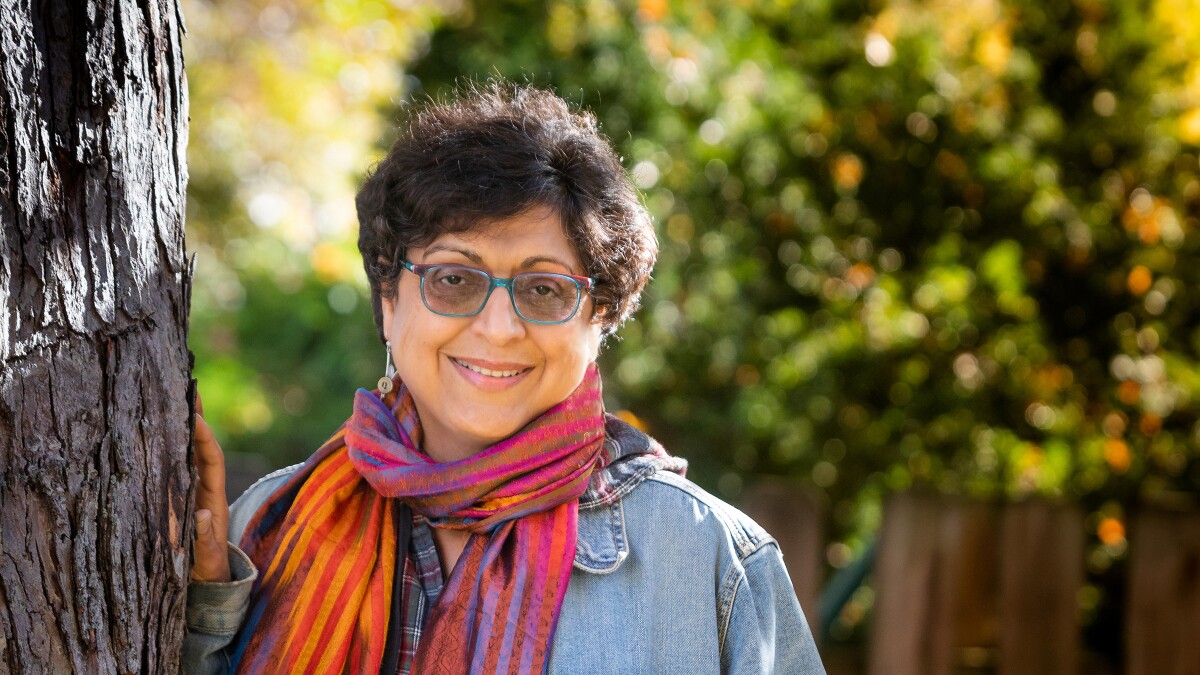
In Thrity Umrigar’s ninth novel, Honor, we meet Smita, an Indian American journalist called back to India to cover the story of Meena, a Hindu woman burned by her own brothers for marrying a Muslim man. During Smita’s return to India, she grapples with her own conflicted feelings towards her home country, confronts the traumatic events that caused her family to leave India, and falls in love with Mohan, an Indian man who acts simultaneously as a translator, an ambassador to India, and a friend to Smita. Ultimately, the novel is a reflection of what growth, strength, and love can look like for two women of very different backgrounds.
Umrigar is the bestselling author of nine novels, a memoir, and three children’s books. She was a finalist for the PEN/Beyond Margins award for her novel The Space Between Us and is the winner of the Cleveland Arts Prize. A recipient of the Nieman Fellowship to Harvard, she is currently a Distinguished University Professor of English at Case Western Reserve University in Cleveland.

Audrey Fong: Mohan and Smita represent opposites in their views of India. Mohan initially views India as the best country in the world, while Smita sees it as a site of trauma and detests a lot about India. How did you use their opposing opinions on India to explore the complicated feelings an Indian American may experience towards their country of ancestry?
Thrity Umrigar: I wanted them to come from two diametrically opposed standpoints at the start of the novel and then to have them each move toward the center–and toward each other–to have a more nuanced, measured response to the country. I think many Indian Americans have a complicated relationship with India and I wanted each of them to arrive at that same point. I also wanted to explore the fact that they grew up in different Indias. Mohan was Hindu, male, the son of an affluent diamond merchant. Smita was Muslim, female, and the daughter of an academic. Their backgrounds influenced how they each related to the country of their birth.
AF: Like Smita, you were born and raised in India and moved to the U.S. at a fairly young age. How did your background influence the novel?
TU: I grew up as a Parsi, a tiny ethnic/religious community in India. So, we were spared the eternal conflict between Hindus and Muslims, occupying neutral territory, as it were. So, in that sense, my background didn’t really influence the novel. It was born more out of the readings I was doing about the treatment of minorities and the time-bound customs and my observations about the power of patriarchy.
AF: Smita travels to India to cover the story of Meena, a Hindu woman who married a Muslim man and whose brothers punished her for said marriage by killing her husband and setting her aflame. We often hear about honor killings in the West and as Honor mentions, many of us in the West are quick to disparage India as a backwards country because of them. How do you hope Honor will reframe our understanding of honor killings?
TU: I think those of us who live in the West have to be really careful in the dismissive manner in which we treat countries with traditions such as honor killings. I mean, I think it’s a moral position to voice our opposition to such feudal beliefs. But a little humility is also in order because we, too, are grappling with issues that affect the autonomy of women’s bodies and sexuality. As we are finding out, freedoms can be snatched away in the blink of an eye. I hope my novel will help readers see parallels instead of differences.
AF: The novel is interspersed with chapters written from Meena’s point of view, while the rest of the novel is written in third person and focuses on Smita’s time in India. How did you get in the mindset to write as Meena?
TU: I conceived of Meena as a character who has very little agency or a voice of her own. All her life, she has been acted upon rather than been an actor in her own life. She has been told by the men around her how to conduct herself, how to act, how to love, whom to love. So, it was important to me to restore Meena’s voice back to her. I wanted her to talk directly to the reader in her own voice and syntax, and for once, tell her own story. So it was a political decision as much as it was a literary one.
AF: Towards the end of the novel, Smita contemplates her role as a journalist, wondering if she’s just selling poverty porn to the West. As a journalist yourself, do you think there’s a way journalism can serve others without putting them on display or turning them into objects of pity?
TU: I’m one of those people who believes that intentions matter. They matter in journalism as much as they matter in life. If you don’t treat your subjects as objects to be pitied, if you see your role as clearing a path for them to tell their own stories and represent themselves, then I think you can absolutely serve them without exploiting their poverty or their suffering. Indeed, journalism can be a very powerful tool for exposing injustice, as I think Smita eventually discovers in her telling of Meena’s story.
AF: Lastly, you’ve been writing for several decades now and you’re a prolific writer with multiple novels, several children’s stories, and a memoir published. How do you keep yourself writing and how has the writing process changed for you?
TU: Honestly, I don’t ever have to “keep” myself writing. It gives me so much joy and pleasure to write that I have to make myself do every other thing in my life, such as making the bed and keeping my desk clean. The writing process has changed only in that I no longer have structured hours in which I write. Life has gotten too busy and complicated for that. Now, I write whenever and wherever I can.
Honor is available from Barnes & Noble, Bookshop, Book Soup, Loyalty Bookstore, Powell’s City of Books, and Trident Booksellers & Cafe.

Audrey Fong is a writer, interested in food, coming of age stories, and Asian American narratives. She earned her B.A. in English from UC Irvine and is currently pursuing an M.F.A. in creative writing from Chapman University. She is the co-founder and co-editor of Soapberry Review.