By Justine Trinh
Like The Great Gatsby, I was also required to read Frankenstein during my high school years. Framed as one of the most well-known works of literature, I initially thought I would dislike Frankenstein or find it droll. As I read, however, I felt Mary Shelley’s feelings of grief, guilt, and abandonment, plus the desire for parental comfort, imbued in her words, and I found them just as valid today as they were in 1818. When the monster confronts Victor and states, “At length I wandered towards these mountains, and have ranged through their immense recesses, consumed by a burning passion which you alone can gratify… I am alone, and miserable; man will not associate with me”—that hit home for me. It spoke to this loneliness and isolation I felt in high school since my school at the time was predominantly white (demographics now state it is about 12% Asian, but when I attended, it was closer to 8%). With slogans like “Fountain Valley High School (the rival school down the street) has more Nguyens, but we have more football wins” going around, I felt like an insidious outsider that no one wanted to associate with or could relate to, and my parents could not understand these feelings I experienced every time they dropped me off.
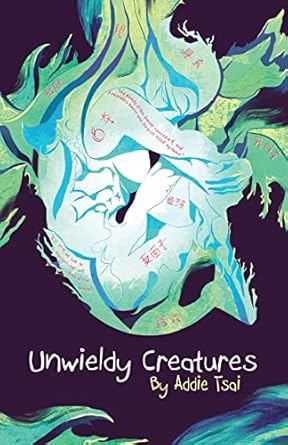
Yet despite the continued relevancy of Shelly’s words, Addie Tsai’s biracial, queer, nonbinary retelling of Frankenstein, Unwieldy Creatures, takes the novel into the 21st century to discuss more current concerns. Shelly’s Frankenstein does not include queer, nonbinary, or people of color as Western literature at the time tended to focus on the rich white male subject. Whereas Shelly was influenced by galvanism (the generation of electricity in biological organisms, and this electric current causes the body to convulse), Tsai was inspired by in vitro fertilization (IVF) and abortion bans and wanted to write a book that paid homage to the original.
Unwieldy Creatures utilizes the same introductory narrative framework of Frankenstein: it is a frame story that takes place in a letter. In the prologue, the reader is introduced to the Captain Walton equivalent character of Plum, who is writing a letter that explains how she met Dr. Frank, a scientist who specializes in embryology. Plum is an intern at Dr. Frank’s embryology, and after Dr. Frank experiences a breakdown, Plum is tasked with taking the doctor home. Once home, Dr. Frank tells Plum her life story that explains her motivation to procreate without sperm or egg, but rather using stem cells to create the necessary reproductive cells. Yearning to create life, Dr. Frank risks everything including her relationship with her lover, Hana, and engages in unethical actions to advance medical science for her own ambition. While her experiment is a success, Hana dies from childbirth, and Dr. Frank abandons her nonbinary creation, Ash, in the forest. Just like Frankenstein, the creature returns to wreak havoc on dia (Ash’s pronoun) creators.
Unwieldy Creatures tackles many issues that we as a society are grappling with, such as toxic masculinity and consent. Tsai wrote with intention to address these issues as they have “a deeper understanding of toxic white masculinity than Shelley could have imbued [Frankenstein] with, whether she understood its cracks and violences or not.” This is evident with the character of Ezra, Dr. Frank’s adopted brother. Dr. Frank’s father goes to Indonesia and marries a woman there because he wants an “exotic” wife. However, when Dr. Frank is born brown as a biracial child, her father wants “a child untainted by [Dr. Frank’s] mother’s dark skin and foreign blood,” and as a result, he adopts Ezra. However, Ezra is not the masculine son he wants: Ezra is described as having an “innocent comportment;” he prefers to play with fabrics. This angers their father, who burns Ezra’s silks and breaks his spirit. This moment indoctrinates Ezra into the cult of toxic masculinity as he parrots his father’s extreme tenets that prioritize patriarchy and dominant male rule. Ezra demands Dr. Frank marry him because that was their father’s last wish without considering Dr. Frank’s queer identity. When he is rejected, he breaks into the lab and inseminates Dr. Frank’s eggs so that he can create a biological child with her without her consent. Because Ezra is a man, he believes his desires eclipse everyone else’s, and he does not care who gets hurt in the process as this fertilized egg is later put into Hana, who believes the child is hers and Dr. Frank’s.
Hana’s character illuminates the feminist concern of female bodily autonomy in which women’s bodies are reduced to a vessel for procreation. With the Supreme Court’s overturning of Roe v. Wade, this fear of denying female bodily autonomy has become abundant within horror films such as Immaculate and The First Omen depicting women forced to give birth to babies they do not want. Similarly, Hana has no power or say over her own body as she is impregnated without her consent or knowledge that the fertilized egg was not related to her biologically. Dr. Frank, who claims to love Hana, knows Ezra’s actions and still chooses to impregnate Hana to fulfill her ambitious goal of creating life without using reproductive cells. Thus, Hana becomes secondary to Dr. Frank’s scientific pursuits and is denied any bodily agency because by the time Hana discovers this duplicity, it is too late to abort the pregnancy and she ultimately dies.
There is this anonymous quote that came up in my class the first time I read Frankenstein that states, “Knowledge is knowing that Frankenstein is not the monster. Wisdom is knowing that Frankenstein IS the monster.” Within popular culture, the creature is often mistakenly called Frankenstein. While the creature does engage in monstrous actions, the true monster is Victor Frankenstein himself who allowed ambition to ruin his life and cause the death of his loved ones. Within Unwieldy Creatures, monstrosity begets monstrosity. Initially, the children are seen as monsters, but in actuality, the parents are the true monsters in their attempt to “fix” their children’s perceived flaws. Ezra and Dr. Frank’s father describes his children as “perverse spawns” and their non-heteronormative traits as “monstrosities,” and it is his responsibility to fix them. He verbally insults them, assaults them, and burns evidence of Ezra’s non-masculine interests and Dr. Frank’s queerness. However, these actions cast him and the toxic masculinity as the true monster that both Ezra and Dr. Frank cannot escape even after he dies, and ultimately, they become monsters when it comes to the creation of Ash. Ezra forces himself into Dr. Frank’s experiment, which leads to the creation of Ash, and Dr. Frank forces Hana to carry the child to term. When Ash confronts Dr. Frank for dia abandonment, she refuses to acknowledge dia gender identity and continues to misgender Ash, perpetuating the same behaviors her father hurt her with. When Plum broaches this incident, Dr. Frank does not acknowledge her and treats Plum as another bodily vessel for her scientific aspirations. Although Dr. Frank and Ezra did not start out as monsters, they become so. In Ezra’s case, it was the toxic masculinity that he had come to fear, and he learned that if he embraced it, then he would not be hurt. For Dr. Frank, it is her ambition to prove that she could create life and defy nature.
At times, I felt this novel was a bit on the nose with its references and themes to Frankenstein such as Dr. Frank’s name, the narrative framework, and the creature, but I do not think that detracted from the overall message Tsai conveys. The book takes the Frankenstein story and places it in a modern-day environment to give a critique on toxic masculinity and female bodily autonomy, which are issues of current contention in our political climate. Through Unwieldy Creatures, Tsai shows the reader that the true horrors are not imaginary creatures, but rather these real-world concerns that can embolden good people to do horrible things. None of the main characters start off as inherently evil, but through violence and fear that result from toxic masculinity, they ultimately engage in monstrous actions.

Justine Trinh is an English literature Ph.D. student at Washington State University. She graduated from the University of California, Irvine with B.A.s in Asian American studies and classical civilizations and a B.S. in mathematics. She then went on to earn her M.A. in Asian American studies, making her the first student to graduate from UCI Asian American Studies’ 4+1 B.A./M.A. program. Her research interests include Asian American literature, critical refugee studies, family and trauma, and forced departure and disownment.